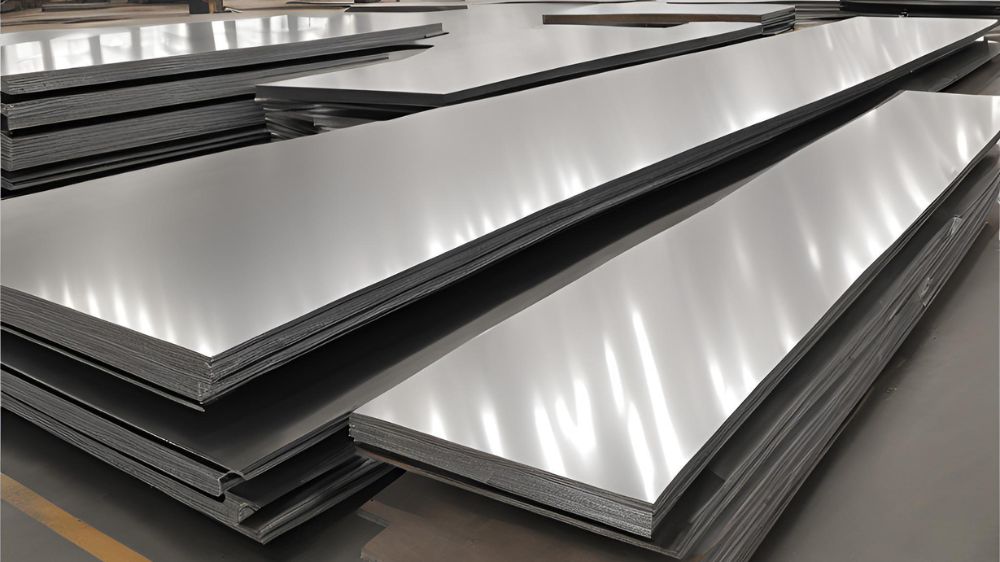

Stainless steel 304 sheets come in four finishes. They are a 304 finish, a 316 finish, a 316L finish, and an 18% chromium finish.
304 Stainless Steel Sheet Finish
Stainless Steel 304 sheet finish is one of the most commonly used stainless steel sheets. It is widely used in architectural designs, kitchen equipment, and industrial equipment. This material is also commonly found in aerospace structures. Its high corrosion resistance makes it an ideal candidate for a variety of applications.
The chromium oxide layer, which is self-renewing, prevents oxygen diffusion. Stainless Steel 304 Sheets also offers good forming and welding properties. The low carbon content minimizes the risk of carbide precipitation during welding.
Unlike other grades of stainless steel, 304 stainless steel does not require heat treatment after welding. The annealed condition is non-magnetic, and it can be hardened by cold working. It has excellent rust resistance, and its flexible nature makes it easy to work. The grade is also suitable for most processing techniques.
304 stainless steel sheet is available in a range of widths and lengths to fit different applications. It is also readily welded by all standard methods. The price is significantly lower than other metallic products.
Chemical Composition
304 stainless steel is one of the world’s most widely used types of stainless steel. Have relatively low-carbon alloy, containing a minimum of 18 per cent chromium and a maximum of 0.08% nickel. It is also very corrosion-resistant. Also is particularly suited for applications in the food industry, such as a piece of dairy equipment, and for containers and storage tanks.
304 is a highly malleable, low-cost material that is easily worked and has good forming and welding properties. It is also resistant to chloride and other chemical corrodents, making it suitable for use in industrial and marine environments. It is also straightforward to clean.
304 is a standard material used for many types of products, including coffee urns, milk and cream dispensers, and fasteners. It is also commonly used in site furnishings and buildings. It is also used in the citrus juice industry and dairy equipment.
The tensile strength of 304 is 205 MPa, while the corrosion resistance of 304 is slightly better than that of other grades of stainless steel. Unlike carbon steel, 304 is not electrically conductive.
Machinability
Stainless steel 304 is one of the most common types of alloys, and it is used in a wide range of industries. It is known for its excellent strength and corrosion resistance, making it ideal for many applications. However, it is essential to understand the differences between 304 and 316, so you can decide which type of stainless steel to use.
Stainless steel 304 is a chromium-nickel alloy. His contains between eight and ten per cent nickel, with a maximum of 0.08 per cent carbon is also a non-magnetic alloy.The commonly used in chemical containers, heat exchangers, and kitchen appliances.
SS 304 is considered a highly weldable material. It can be hot rolled or cold worked to achieve a higher hardness, tensile strength, and resistance to corrosive environments. In addition, it is aesthetically pleasing in various environments.
Although 304 is a more machinable metal than 303, it does not have the same level of corrosion resistance. It is also less thermally conductive than carbon steel. It is prone to pitting in warm, chloride-based environments.
Different Between 304 & 316 SS Sheet
Stainless steel 304 sheets 316 is a high-performing alloy that has become popular for a variety of uses. They offers a combination of corrosion resistance, form ability, and strength that is ideal for demanding environments. Moreover is also easy to clean and sanitize. Like wise is often used in medical and industrial applications. It is a popular choice in the aerospace industry.
Compared to 316, 304 is less expensive, but it does not have the same level of chloride resistance. It is worth paying the extra cost for areas with a lot of chloride exposure.
Stainless steel 316 is commonly used in the marine industry. Its high nickel content makes it more resistant to corrosion, particularly in saltwater environments. It also has higher tensile strength, a force required to split a material. This allows it to resist better pitting and crevice corrosion.
Another difference between 304 and 316 is the amount of carbon included. While 304 is not a carbon-rich metal, 316 has a small amount of carbon that reduces weld ability.